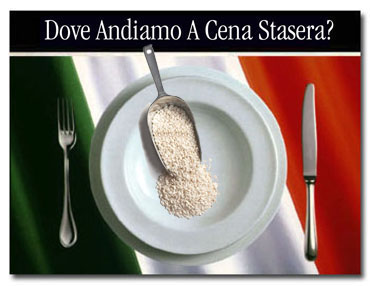

Rice is a food made from the caryopsis produced by various plants of the tribe Oryzeae (genera: Oryza and Zizania), suitably processed.
The most well-known species used are Oryza sativa (from which "Asian rice" is obtained) and Oryza glaberrima (from which "African rice" is obtained).
Rice is by far the most consumed cereal by the human population: it is the staple of Asian cuisine and is present in the gastronomic traditions
of the entire world. It constitutes the main food for approximately half of the world's population[1] and is cultivated in almost every country in the world.
It is the third largest agricultural product by world production (755 million tonnes recorded in 2019 - FAO estimates), after sugarcane
(1.9 billion tonnes) and maize (1.0 billion tonnes).[2] Also noteworthy is wild rice (Zizania) which, unlike the varieties
derived from Oryza sativa and Oryza glaberrima plants, usually grows in the wild state. However, this type of rice can also be
marketed and can constitute a culinary delicacy.
In Italy
After rice had been used for centuries for therapeutic purposes, it began to be cultivated in Italy as well. There are three hypotheses about the origins of rice growing in the
peninsula: the first traces it back to the Arabs in the year 1000 in Sicily; the second dates it to the Aragonese at the end of the fourteenth century in Naples; and the third
attributes it to Venetian merchants from the East. It is certain that over time rice cultivation developed most extensively in the Lombardy area, where the presence of flooded land
offered ideal conditions for its cultivation[29]. The first Italian rice field was inaugurated in 1468, and the first document proving its cultivation
in Italy was a covering letter signed by Galeazzo Maria Sforza on 28 September 1475, with which he sent 12 sacks of rice
to the Duke of Ferrara. With the first Lombard cultivations, rice became an element of the local diet. Cultivation spread rapidly in the
marshy areas of the Po Valley, generating an increase in malaria cases. Measures to limit its cultivation near populated areas
did not stop the expansion of rice, also because it guaranteed higher earnings than other cereals. Another reason for its spread was probably
the extensive use made of it in the sixteenth century, when famine and plague had reduced populations to starvation throughout the western Mediterranean.
Cultivation then spread first to Emilia and then to Tuscany, where however it was limited due to the lesser availability of water. Towards the end of the seventeenth century
there were many cultivations in the Po Valley, in Tuscany and in some areas of Calabria and Sicily. In 1700 the rice fields of the Milan area occupied an area
of over 20,000 ha, while in 1850 in the Vercelli area alone approximately 30,000 ha were devoted to cultivation.
(source Wikipedia)
(selection 2026)